Polycystic ovary syndrome: navigating diagnostic criteria
Polycystic ovary syndrome (PCOS) is common, but its diagnostic criteria are often applied inconsistently. The difficulty is not a lack of definitions. It is knowing which findings count, when they need to be combined, and how age changes the interpretation.
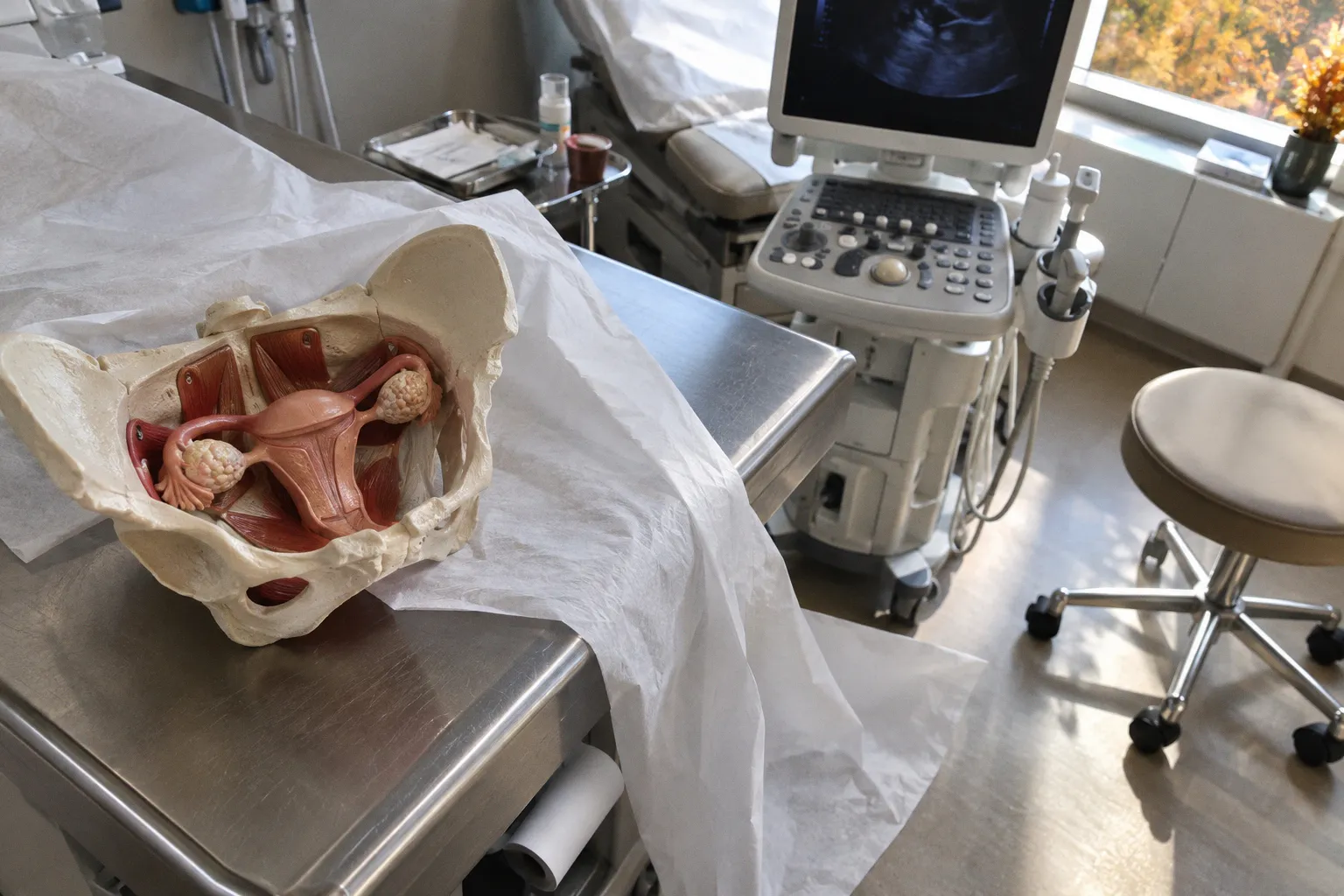
For someone looking into the polycystic ovary syndrome diagnostic criteria for irregular cycles, the central point is that cycle patterns are only one part of an age-specific assessment.
The 2023 International Evidence-Based Guideline retained the adult two-of-three diagnostic framework while clarifying how clinicians use it. Ovulatory dysfunction, hyperandrogenism, and polycystic ovarian morphology can contribute to a diagnosis, but they are not interchangeable in every situation. Adolescents follow stricter rules, and other conditions that can resemble PCOS must be considered before the diagnosis is confirmed.
The 2023 International Evidence-Based Guideline: A Shift in Diagnostic Standards
The Rotterdam criteria for PCOS, established in 2003, require two of three features in adults: clinical or biochemical hyperandrogenism, ovulatory dysfunction, and polycystic ovarian morphology on ultrasound. The 2023 update retained that framework but clarified how the features are assessed and when additional testing is needed.
One notable change is that serum anti-Müllerian hormone (AMH) can be used as an alternative to ultrasound for identifying polycystic ovarian morphology in adults. AMH is not an independent fourth criterion. It can help establish the ovarian-morphology feature when that feature is needed to complete the assessment. Because interpretation depends on the assay and laboratory reference ranges, there is no single universal AMH cut-off that applies everywhere.
The guideline also makes clear when imaging and AMH are unnecessary. If an adult has both irregular cycles and clinical or biochemical hyperandrogenism, those two features satisfy the diagnostic threshold once relevant mimicking conditions have been excluded. Ultrasound or AMH does not need to be added simply to make the diagnosis feel more certain.
Adolescent assessment is different. Ultrasound and AMH are not used to diagnose PCOS in teenagers because ovarian appearance and AMH levels can overlap with normal pubertal development. Adolescents need both persistent cycle irregularity, defined according to time since menarche, and hyperandrogenism.
The criteria work best as a sequence: establish which features are present, interpret them in the context of age, then rule out conditions that can look like PCOS.
This framework helps make sense of the PCOS diagnosis requirements without turning a single symptom, blood result, or ultrasound report into a diagnosis by itself.
Defining Ovulatory Dysfunction: Cycle Thresholds and Clinical Patterns
For PCOS assessment, irregular cycles are defined mainly by cycle length and frequency, with thresholds that change according to how much time has passed since menarche. A late or unpredictable period can be relevant, but the pattern must be interpreted in context.
In adults from three years after menarche to perimenopause, cycles are considered irregular if they are shorter than 21 days, longer than 35 days, or occur fewer than eight times a year. A cycle lasting more than 90 days is also considered abnormal more than one year after menarche, even if other cycles are within the usual range.
Adolescent thresholds account for the normal maturation of the reproductive system:
| Time since menarche | Cycle pattern considered irregular |
|---|---|
| Less than 1 year | Irregularity is generally part of the normal pubertal transition and does not, by itself, support a PCOS diagnosis |
| 1–3 years | Cycles shorter than 21 days or longer than 45 days |
| More than 3 years | Cycles shorter than 21 days, longer than 35 days, or fewer than 8 cycles per year |
| More than 1 year after menarche | A single cycle longer than 90 days is abnormal |
These thresholds matter because cycle variation is common in the first years after menarche. A teenager’s pattern should not be judged using adult cut-offs simply because the cycles seem unpredictable. Doing so can turn normal development into a premature diagnosis.
For adults, regular-looking cycles do not always prove that ovulation is occurring. Anovulation can happen within cycles of typical length. If a patient has signs of hyperandrogenism but reports regular cycles, a clinician may use a mid-luteal progesterone measurement to clarify whether ovulation is taking place. This is a targeted way to investigate uncertainty, rather than assuming that calendar regularity settles the question.
The phrase “irregular periods and PCOS testing” therefore covers more than deciding whether a cycle is late. It involves documenting cycle length and frequency over time, noting how long it has been since menarche, and considering whether the history suggests ovulatory dysfunction.
Hyperandrogenism and the Role of Biochemical Testing
Hyperandrogenism can be identified through clinical signs, blood testing, or both. The guideline does not require every patient to have both visible symptoms and elevated laboratory results. Either clinical hyperandrogenism or biochemical hyperandrogenism can count as one of the diagnostic features.
Clinical signs include hirsutism, acne, and androgenic hair loss. Hirsutism is often assessed with the modified Ferriman–Gallwey score, which evaluates terminal hair growth in several areas of the body. Its interpretation requires care: hair growth varies across ethnic groups, and a single threshold may not describe every patient equally well. The pattern, degree, and context of hair growth matter more than treating a score as an answer on its own.
Biochemical assessment looks for elevated androgens. Total testosterone and free testosterone are commonly considered, and androstenedione may also be useful in some cases. Reliable measurement matters. Results need to be interpreted alongside the patient’s symptoms, cycle history, medications, and the reference range used by the laboratory.
Sex hormone-binding globulin (SHBG) also matters because it affects how much testosterone is available in its unbound form. The free androgen index, calculated using total testosterone and SHBG, can be used to assess biochemical hyperandrogenism in PCOS. Low SHBG can raise the index, so its result should be read in the context of the underlying measurements and the patient’s clinical picture. It is part of the biochemical assessment, not a reason to disregard that assessment.
Hormonal blood tests for PCOS are most useful when they answer a specific clinical question. A normal androgen result does not erase clear clinical hirsutism; conversely, acne alone may have other explanations and should not automatically be treated as proof of PCOS. The aim is to bring together findings that can be assessed consistently, rather than letting one borderline result decide the diagnosis.
Hormonal contraception can also complicate interpretation of androgen testing. When results are difficult to interpret, the clinician may need to consider the effects of current or recent medication and decide whether testing can be meaningfully performed under those circumstances. Patients should not stop prescribed medication without discussing it with their clinician.
Imaging and AMH: When Ultrasound Findings Are Required for Diagnosis
Ultrasound findings in PCOS diagnosis are useful only when they answer a question the other criteria have left open. In adults, polycystic ovarian morphology may be identified by follicle number or ovarian volume. The guideline describes morphology using 20 or more follicles in at least one ovary with appropriate modern imaging, or ovarian volume of at least 10 cm³ when follicle counting is less reliable. Imaging technique and equipment affect what can be counted, so a report should be interpreted in light of how the scan was performed.
If an adult already has both ovulatory dysfunction and hyperandrogenism, ultrasound is not required to establish the diagnosis. If one of those features is absent or unclear, ultrasound or AMH may help determine whether the third feature is present.
Ovarian morphology on its own is not PCOS. Some people without the syndrome have ovaries that appear polycystic on imaging. The finding must be considered alongside cycle patterns and androgen status; it cannot stand in for them.
Transvaginal ultrasound generally provides better detail for follicle assessment than transabdominal imaging. It may not be appropriate or acceptable for every patient. AMH can offer an alternative way to assess the ovarian-morphology feature in adults, but it is not used as a shortcut to diagnosis and does not replace the need to consider the other features.
An ultrasound describes ovarian appearance. Its diagnostic meaning depends on the rest of the clinical picture.
Navigating Adolescent PCOS: Why Standard Criteria Do Not Apply
Adolescent diagnosis calls for restraint. During puberty, cycle patterns are still developing, and ovarian morphology and AMH can resemble findings associated with PCOS in adults. That overlap is why the adult criteria cannot simply be carried over.
For an adolescent, both persistent menstrual irregularity and clinical or biochemical hyperandrogenism must be present. The cycle thresholds depend on time since menarche: irregularity during the first year is generally part of normal pubertal transition, while the thresholds become more specific in the years that follow. Ultrasound and AMH are not used to establish an adolescent diagnosis.
This means that irregular periods alone do not establish PCOS in a teenager. Neither does an ultrasound report describing polycystic ovarian morphology. If hyperandrogenism is absent, the diagnostic criteria are not met. The same applies when hyperandrogenism is present but cycles are not persistently irregular by the age-specific definition.
When a young person has some features but not enough to meet the criteria, the picture can be revisited over time. That is different from dismissing symptoms. It recognizes that puberty changes the meaning of several findings and that early certainty may not be possible. Care can still address symptoms and support the patient while the pattern becomes clearer.
The Exclusion Process: Ruling Out Mimicking Endocrine Disorders
PCOS is diagnosed after considering conditions that can also cause irregular cycles or excess androgen effects. The appropriate tests depend on the presentation, but the exclusion process is a necessary part of assessment, not an optional extra after a diagnosis has already been decided.
Conditions commonly considered include:
- Non-classic congenital adrenal hyperplasia (CAH). This can cause androgen excess and menstrual irregularity. A 17-hydroxyprogesterone test is used in the initial assessment; an abnormal result may lead to further testing.
- Thyroid dysfunction. Both underactive and overactive thyroid function can affect menstrual cycles. TSH is commonly used to assess thyroid function.
- Hyperprolactinemia. Elevated prolactin can disrupt reproductive hormone signaling and contribute to irregular periods.
- Androgen-secreting tumors. These are uncommon, but rapid-onset symptoms, marked androgen elevation, or signs of virilization call for prompt assessment rather than routine attribution to PCOS.
Other conditions, including Cushing syndrome, acromegaly, and primary ovarian insufficiency, may be considered when symptoms, examination, or test results point away from a typical PCOS presentation. No single panel is appropriate for every patient. The workup should follow the clinical clues.
A sudden change in symptoms deserves particular attention. Gradual hair growth or acne can fit a range of conditions; rapid progression or pronounced virilization changes the level of concern. The same principle applies to laboratory results: a finding should be interpreted in context, and an unexpectedly marked result should prompt a clinician to look beyond the most familiar explanation.
Applying the Criteria in Practice
The adult framework is straightforward when the evidence lines up: assess cycle patterns, assess hyperandrogenism, and use ultrasound or AMH only if a third feature is needed. Then consider conditions that could produce a similar presentation. For adolescents, persistent irregularity and hyperandrogenism are both required, and ultrasound and AMH are left out of the diagnostic criteria.
The careful part is deciding what each finding means. A long cycle may carry a different significance in the first year after menarche than it does in an adult. An ultrasound finding does not establish a syndrome by itself. A blood result, including the free androgen index, belongs in the assessment but still needs clinical interpretation.
A PCOS diagnosis should rest on a pattern of findings that fits the patient’s age and presentation, with important mimics considered. That is what makes the criteria useful: they guide judgment without asking one symptom or test to do the work of the whole diagnosis.